
Michigan Paycheck Calculator

Free Michigan Paycheck Calculator — estimate your exact take-home pay after federal tax, Michigan
state tax (4.25%), Social Security & Medicare. Detroit workers can include local city tax too. Fast, free and accurate!

How are you paid?
Gross Pay per Paycheck
$
Your pay before taxes — check your pay stub or offer letter
Please enter your gross pay to calculate.
How often are you paid?
Filing Status
Do you live or work in Detroit?
Detroit charges a local income tax on top of Michigan state tax. Residents pay 2.4% and non-residents working in Detroit pay 1.2%.
Add deductions & benefits (optional)
401(k) per paycheck
$
Pre-tax · max $24,500/yr
Health Insurance
$
Pre-tax · per paycheck
HSA Contribution
$
Pre-tax · max $4,400/yr (single)
Other Deductions
$
Life insurance, garnishments, etc.
Your Estimated Take-Home Pay
$0.00
per bi-weekly paycheck
💰 You keep 0% of your paycheck
0%
Fed Tax Rate
Your effective federal income tax rate — average rate on your full paycheck, not your top bracket rate.
0%
MI Tax Rate
Michigan flat state income tax of 4.25% for 2026 plus any applicable Detroit local tax.
0%
Total Rate
Combined federal + Michigan state + FICA (Social Security & Medicare) as a % of your gross pay.
Per Paycheck Breakdown
Gross Pay$0
Pre-Tax Deductionsi401(k), health insurance, HSA — reduces your taxable income before taxes are calculated.
Federal Income TaxiCalculated using 2026 IRS progressive brackets (10%–37%) based on your filing status and taxable income.$0
Social Security (6.2%)iFederal FICA tax — 6.2% of gross pay up to the $184,500 annual wage cap for 2026.$0
Medicare (1.45%)iFederal FICA tax — 1.45% on all wages. An extra 0.9% applies above $200,000 (single) or $250,000 (married).$0
Michigan Income Tax (4.25%)iMichigan has a flat 4.25% state income tax rate for 2026. No SDI tax in Michigan.$0
Take-Home Pay$0
Estimated Annual Take-Home $0
⚠️ Estimates only — 2026 IRS Rev. Proc. 2025-32 · Michigan Treasury. SS cap $184,500 · 401(k) max $24,500.
Detroit residents/workers may owe additional local income tax. Consult a tax professional for exact figures.

How to Calculate Your Michigan Paycheck

Three steps. Under 60 seconds. No account needed.

1Enter Your Gross Pay

The number on your pay stub before taxes — usually labeled "Gross Pay". You can also switch to hourly mode and enter your hourly rate and hours per week.

2Pick Pay Frequency & Filing Status

Choose weekly, bi-weekly, semi-monthly, or monthly — then select single, married, or head of household. Detroit workers can also select their local city tax rate.

3Get Your Instant Results

See federal tax, Michigan state tax (flat 4.25%), Social Security, Medicare, and your exact take-home pay — broken down per paycheck and annually.
Pro tip: Add optional deductions like 401(k) or health insurance for a more precise result — and see exactly how much they reduce your Michigan tax bill.
Michigan Paycheck Calculator

What Gets Deducted From Your Michigan Paycheck?

Every Michigan paycheck has two layers of deductions — federal and state. Federal taxes include income tax
(10%–37%), Social Security (6.2%) and Medicare (1.45%). Michigan adds a flat state income tax of 4.25% —
one of the lowest flat rates in the country.

Unlike most states, some Michigan cities charge a local income tax. Detroit residents pay an extra
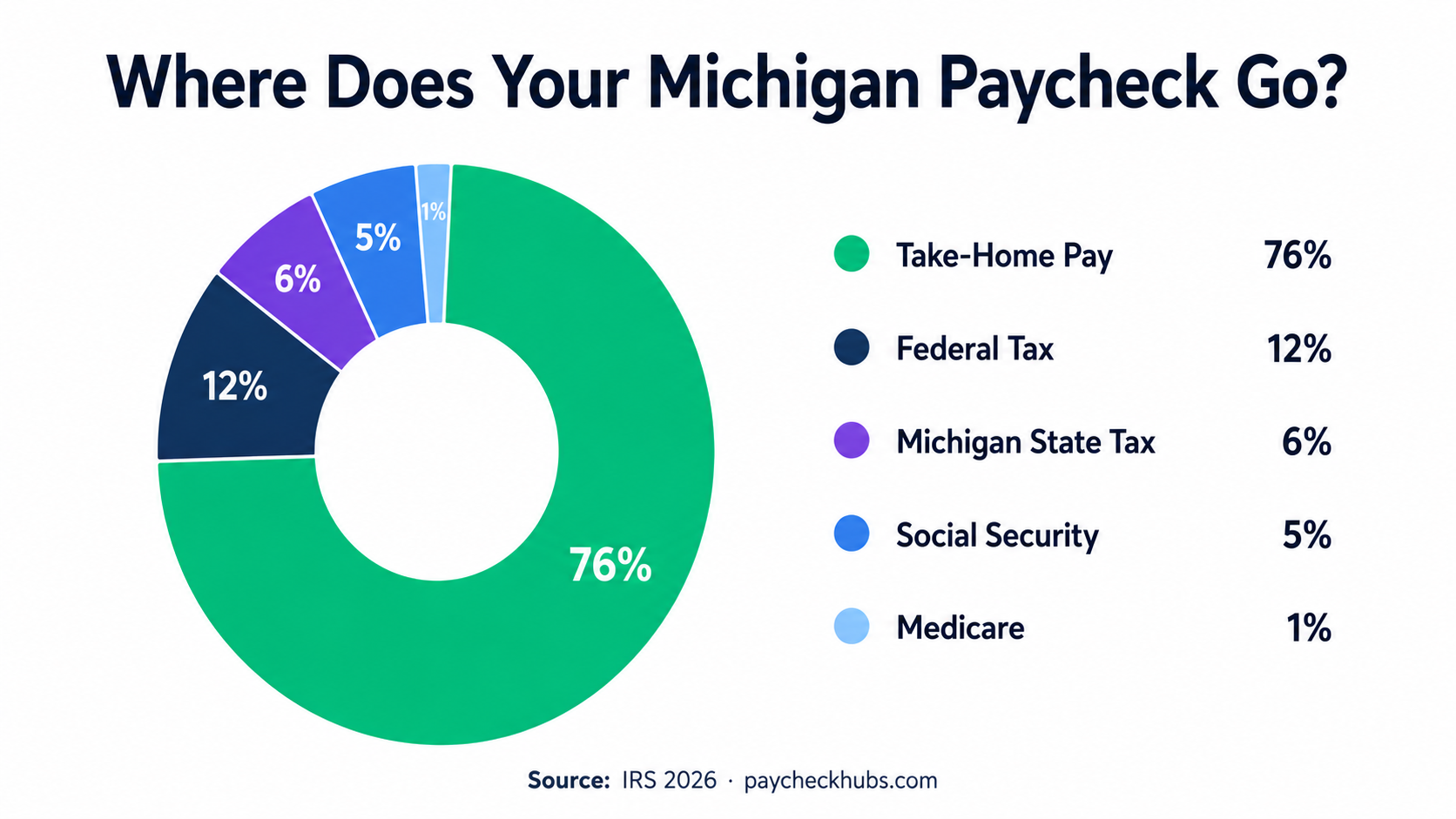
2.4% and non-residents working in Detroit pay 1.2%. After all deductions, most Michigan workers keep
between 74%–80% of their gross pay. Use the Michigan Paycheck Calculator above to see
your exact take-home pay.

Michigan Payroll Taxes at a Glance

Here’s a quick reference for the federal and Michigan taxes that impact your take-home pay in 2026.

TaxRateDetails
Federal Income Tax 7 Brackets 10% – 37% Federal tax rates vary based on taxable income and filing status.
Social Security 6.2% Applies to wages up to $184,500 in 2026.
Medicare 1.45% Applies to all wages with no annual wage limit.
Michigan Income Tax Flat Rate 4.25% Michigan uses a simple flat tax — same rate for all income levels and filing statuses.
Detroit Local Tax Detroit Only 2.4% / 1.2% Detroit residents pay 2.4%. Non-residents working in Detroit pay 1.2%.
Michigan SDI None 0% Michigan does not have a State Disability Insurance tax.
Michigan Standard Deduction $5,400 Standard deduction for single filers. $10,800 for married filing jointly.
Federal Income Tax
10%–37%
7 brackets — varies by taxable income and filing status.
Social Security
6.2%
Applies to wages up to $184,500 in 2026.
Medicare
1.45%
Applies to all wages with no annual limit.
Michigan Income Tax
4.25%
Flat rate — same for all income levels and filing statuses.
Detroit Local Tax
2.4% / 1.2%
Residents: 2.4% · Non-residents working in Detroit: 1.2%.
Michigan SDI
None
Michigan has no State Disability Insurance tax.
Standard Deduction
$5,400
Single filers. Married filing jointly: $10,800.

Michigan has one of the simplest state tax systems in the US — a flat 4.25% rate with no SDI tax. Detroit workers should note the additional local income tax. Use the Michigan Paycheck Calculator above to see exactly how these rates affect your take-home pay.

2026 Federal Tax Brackets

These federal brackets apply to all Michigan workers regardless of which city they live in.

RateIncome RangeTax on This Bracket
10%$0 – $11,925$0 – $1,192
12% Most common$11,926 – $48,475$1,192 + 12% over $11,925
22%$48,476 – $103,350$5,578 + 22% over $48,475
24%$103,351 – $197,300$17,651 + 24% over $103,350
32%$197,301 – $250,525$40,199 + 32% over $197,300
35%$250,526 – $626,350$57,231 + 35% over $250,525
37%Over $626,350$188,770 + 37% over $626,350
Standard Deduction: $15,000 — deducted from gross income before brackets apply
10%
$0 – $11,925
Up to $1,192
12% Most common
$11,926 – $48,475
$1,192 + 12% over $11,925
22%
$48,476 – $103,350
$5,578 + 22% over $48,475
24%
$103,351 – $197,300
$17,651 + 24% over $103,350
32%
$197,301 – $250,525
$40,199 + 32% over $197,300
35%
$250,526 – $626,350
$57,231 + 35% over $250,525
37%
Over $626,350
$188,770 + 37% over $626,350
Standard Deduction: $15,000 — deducted before brackets apply
RateIncome RangeTax on This Bracket
10%$0 – $23,850$0 – $2,385
12% Most common$23,851 – $96,950$2,385 + 12% over $23,850
22%$96,951 – $206,700$11,157 + 22% over $96,950
24%$206,701 – $394,600$35,302 + 24% over $206,700
32%$394,601 – $501,050$80,398 + 32% over $394,600
35%$501,051 – $751,600$114,462 + 35% over $501,050
37%Over $751,600$202,155 + 37% over $751,600
Standard Deduction: $30,000 — double the single filer amount
10%
$0 – $23,850
Up to $2,385
12% Most common
$23,851 – $96,950
$2,385 + 12% over $23,850
22%
$96,951 – $206,700
$11,157 + 22% over $96,950
24%
$206,701 – $394,600
$35,302 + 24% over $206,700
32%
$394,601 – $501,050
$80,398 + 32% over $394,600
35%
$501,051 – $751,600
$114,462 + 35% over $501,050
37%
Over $751,600
$202,155 + 37% over $751,600
Standard Deduction: $30,000 — double the single filer amount
RateIncome RangeTax on This Bracket
10%$0 – $11,925$0 – $1,192
12% Most common$11,926 – $48,475$1,192 + 12% over $11,925
22%$48,476 – $103,350$5,578 + 22% over $48,475
24%$103,351 – $197,300$17,651 + 24% over $103,350
32%$197,301 – $250,525$40,199 + 32% over $197,300
35%$250,526 – $375,800$57,231 + 35% over $250,525
37%Over $375,800$101,146 + 37% over $375,800
Standard Deduction: $15,000
10%
$0 – $11,925
Up to $1,192
12% Most common
$11,926 – $48,475
$1,192 + 12% over $11,925
22%
$48,476 – $103,350
$5,578 + 22% over $48,475
24%
$103,351 – $197,300
$17,651 + 24% over $103,350
32%
$197,301 – $250,525
$40,199 + 32% over $197,300
35%
$250,526 – $375,800
$57,231 + 35% over $250,525
37%
Over $375,800
$101,146 + 37% over $375,800
Standard Deduction: $15,000
RateIncome RangeTax on This Bracket
10%$0 – $17,000$0 – $1,700
12% Most common$17,001 – $64,850$1,700 + 12% over $17,000
22%$64,851 – $103,350$7,442 + 22% over $64,850
24%$103,351 – $197,300$15,912 + 24% over $103,350
32%$197,301 – $250,500$38,460 + 32% over $197,300
35%$250,501 – $626,350$55,484 + 35% over $250,500
37%Over $626,350$187,031 + 37% over $626,350
Standard Deduction: $22,500
10%
$0 – $17,000
Up to $1,700
12% Most common
$17,001 – $64,850
$1,700 + 12% over $17,000
22%
$64,851 – $103,350
$7,442 + 22% over $64,850
24%
$103,351 – $197,300
$15,912 + 24% over $103,350
32%
$197,301 – $250,500
$38,460 + 32% over $197,300
35%
$250,501 – $626,350
$55,484 + 35% over $250,500
37%
Over $626,350
$187,031 + 37% over $626,350
Standard Deduction: $22,500
Source: IRS Rev. Proc. 2025-32 · Last updated June 2026 · Brackets apply to taxable income after standard deduction.

Michigan State Income Tax Brackets

Michigan has one of the simplest state tax systems in the US — a flat 4.25% rate that applies
to all income levels and filing statuses.

Single / MFS / HOH
$5,400
Standard deduction — deducted before 4.25% applies
Married Filing Jointly
$10,800
Standard deduction — double the single filer amount
RateTaxable IncomeHow It Works
4.25% Flat Rate All income All filing statuses Same rate for everyone
Standard Deduction: $5,400 Single · $10,800 Married Jointly · Deducted from gross income before the 4.25% rate applies
Source: Michigan Department of Treasury · Last updated June 2026 · Rate applies to taxable income after standard deduction.

How Michigan state tax works: Michigan uses a simple flat tax — every worker pays exactly 4.25% on their taxable income regardless of how much they earn or their filing status. Detroit residents pay an additional 2.4% local tax on top of this. Use the free Michigan Paycheck Calculator above to see your exact state tax for 2026.

Michigan Take-Home Pay by Salary

Estimated take-home pay for Michigan workers after federal tax, Michigan state tax (flat 4.25%),
Social Security and Medicare. Based on single filer with standard deduction. Detroit local
tax not included.

Gross Salary Federal Tax Michigan State Tax FICA Take-Home Pay Effective Rate
⚠️ Estimates only · Single filer · Standard deduction $5,400 · 2026 IRS & Michigan Treasury rates · SS cap $184,500 · Flat 4.25% Michigan rate · No SDI · Detroit local tax not included · Consult a tax professional for exact figures.

How to use this table: Find your gross salary row to see your estimated Michigan take-home pay. Switch tabs to view monthly, bi-weekly per paycheck, or hourly breakdowns. Detroit residents should add 2.4% local tax to their estimate. For a personalised result with your exact deductions, use the free Michigan Paycheck Calculator above.

Frequently Asked Questions

Find answers to common questions about Michigan paycheck taxes and deductions.
How much is taken out of my paycheck in Michigan?

+
Most Michigan workers keep between 74%–80% of their gross pay. Federal income tax, Michigan state income tax (flat 4.25%), Social Security (6.2%), and Medicare (1.45%) are deducted before you receive your paycheck. Michigan has no SDI tax. Detroit residents pay an additional 2.4% local income tax.

Does Michigan have state income tax?

+
Yes. Michigan has a flat state income tax of 4.25% in 2026. Unlike most states, Michigan uses a single flat rate that applies to all taxable income regardless of how much you earn or your filing status — making it one of the simpler state tax systems in the US.

What is the Michigan state income tax rate in 2026?

+
Michigan's state income tax rate is a flat 4.25% for 2026. This single rate applies to all taxable income for all filing statuses — single, married filing jointly, married filing separately, and head of household. There are no brackets to calculate.

How do I calculate my take-home pay in Michigan?

+
Subtract federal income tax, Michigan state income tax (flat 4.25%), Social Security (6.2%), and Medicare (1.45%) from your gross pay. If you live or work in Detroit, also subtract the Detroit local income tax (2.4% for residents, 1.2% for non-residents). Or use the free Michigan Paycheck Calculator above to get your answer in seconds.

What is the standard deduction in Michigan for 2026?

+
Michigan's standard deduction is $5,400 for single filers and $10,800 for married filing jointly in 2026. This amount is subtracted from your gross income before the flat 4.25% Michigan state tax rate is applied.

Does Michigan have SDI or local income taxes?

+
Michigan does not have a State Disability Insurance (SDI) tax. However, Detroit does charge a local income tax — residents pay 2.4% and non-residents working in Detroit pay 1.2%. No other Michigan cities charge a local income tax.

What is the minimum wage in Michigan in 2026?

+
The Michigan minimum wage is $10.56 per hour in 2026. At 40 hours per week, this equals approximately $21,965 per year before taxes. Use the hourly option in the Michigan Paycheck Calculator above to see your exact take-home pay at any hourly rate.

How much is the Detroit local income tax?

+
Detroit charges a local income tax of 2.4% for residents and 1.2% for non-residents who work in Detroit but live outside the city. This is in addition to Michigan's flat 4.25% state income tax. Use the Michigan Paycheck Calculator above and select your Detroit status to include this in your estimate.