
Free Arizona Paycheck Calculator — Estimate Your Take-Home Pay
Estimate your Arizona take-home pay after federal and Arizona state taxes, Social Security, and Medicare. Enter your pay, filing status, and deductions to see an estimated paycheck breakdown.
Arizona does not have a separate state disability insurance payroll tax. Consult a tax professional for exact figures.
How to Calculate Your Arizona Paycheck
Three steps. Under 60 seconds. No account needed. Check your estimated federal tax, Arizona income tax, Social Security, Medicare, and any deductions you entered. Your actual paycheck may differ based on your W-4, Arizona Form A-4 withholding election, benefits, retirement contributions, and other payroll settings. Arizona’s individual income tax rate is 2.5% for tax years 2023 and later
Enter the amount you earn before taxes and other deductions. You can also switch to hourly mode and enter your hourly rate and hours worked per week.
Select weekly, bi-weekly, semi-monthly, or monthly pay. Then choose the filing status that best matches your federal W-4 information.
See estimated federal income tax, Arizona income tax, Social Security, Medicare, deductions, and take-home pay for each paycheck and for the year.
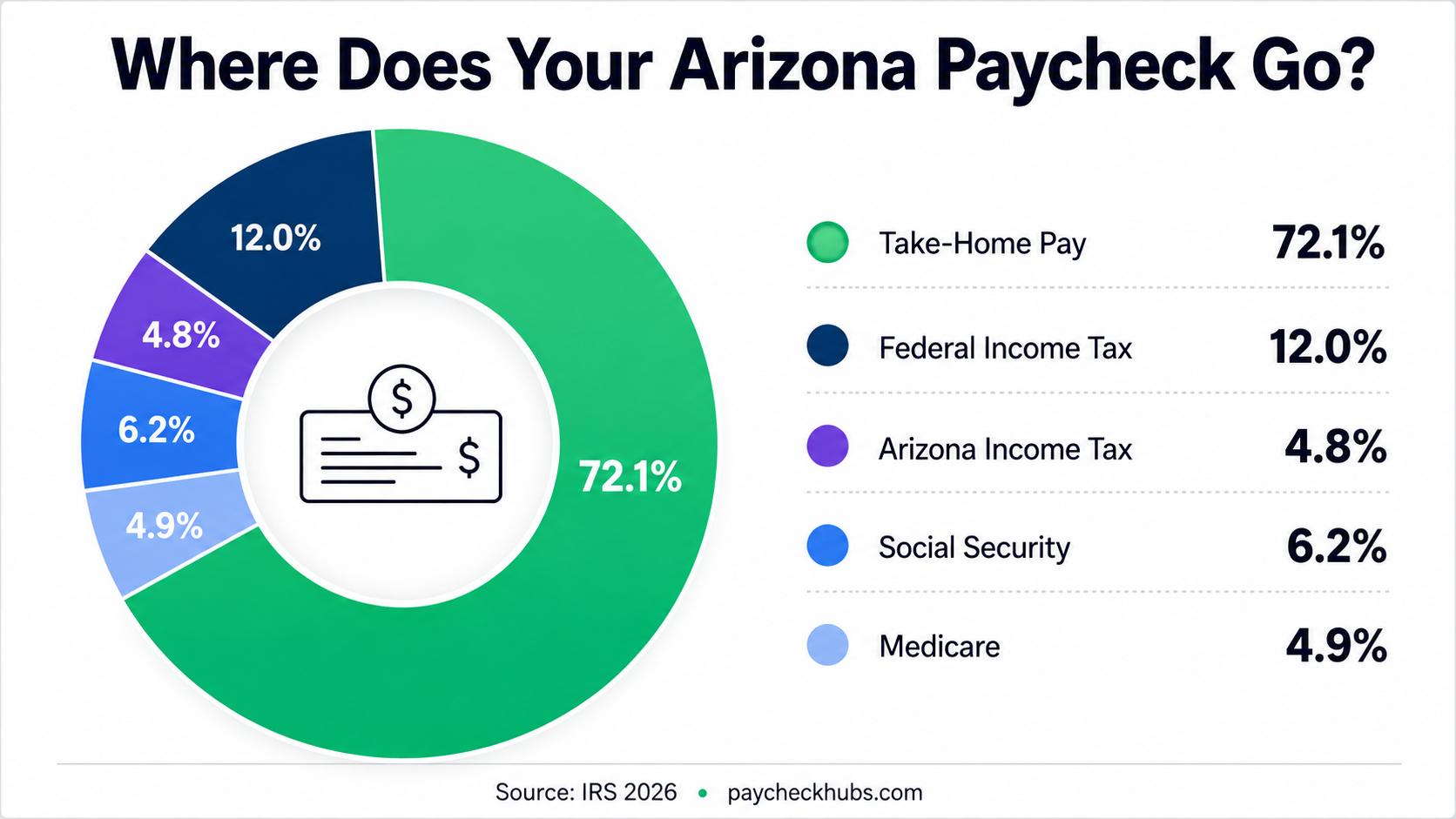
This breakdown shows how an example paycheck can be divided between take-home pay, federal income tax, Arizona income tax, Social Security, and Medicare. Your actual results will vary based on your income, filing status, deductions, and other payroll details.
What Gets Deducted From Your Arizona Paycheck?
Federal Income Tax
Your federal income tax withholding depends on your taxable wages, filing status, and the information you provide on your Form W-4. The amount withheld from each paycheck can differ from your final federal tax liability when you file your tax return.
Social Security
Employees generally pay 6.2% of Social Security-taxable wages. For 2026, Social Security tax applies up to the $184,500 annual wage base.
Medicare
Employees generally pay 1.45% Medicare tax on covered wages, with no annual wage cap. An additional 0.9% Additional Medicare Tax may apply to wages above the applicable threshold; employers begin withholding it once an employee’s wages exceed $200,000 during the calendar year.
Arizona Income Tax
Arizona has a 2.5% individual income tax rate for tax years 2023 and later. However, the amount withheld from your paycheck can vary because employees choose an Arizona withholding percentage on Form A-4. Available withholding percentages include 0.5%, 1.0%, 1.5%, 2.0%, 2.5%, 3.0%, and 3.5%, with an option to request additional withholding.
Other Deductions
Your paycheck may also include deductions for health insurance, 401(k) or other retirement contributions, HSA or FSA contributions, life insurance, garnishments, and other employer-specific benefits or deductions. Whether a deduction is pre-tax or post-tax depends on the type of deduction and the applicable plan or payroll arrangement.
Arizona Payroll Taxes at a Glance
Here’s a quick reference for the federal and Arizona taxes that can affect your take-home pay in 2026
| Tax | Rate | Details |
|---|---|---|
| Federal Income Tax 7 Brackets | 10% – 37% | Federal tax rates vary based on taxable income, filing status, and applicable deductions. |
| Social Security | 6.2% | Applies to covered wages up to the $184,500 Social Security wage base in 2026. |
| Medicare | 1.45% | Applies to covered wages with no annual wage limit. Additional Medicare Tax may apply to higher wages. |
| Arizona Income Tax Flat Rate | 2.5% | Arizona has a flat 2.5% individual income tax rate for the 2026 tax year. |
| Arizona Withholding Form A-4 | 0.5% – 3.5% | Employees can choose an Arizona withholding percentage on Form A-4. They can also request an additional dollar amount to be withheld from each paycheck. |
| State Disability Insurance None | — | Arizona does not have a separate state disability insurance payroll tax. |
| Local Income Tax None | — | Arizona does not have a general city or local individual income tax on employee wages. |
Arizona has a 2.5% individual income tax rate, while the amount withheld from each paycheck can vary based on the withholding percentage selected on Arizona Form A-4. Federal income tax, Social Security, Medicare, and other payroll deductions can also affect your estimated take-home pay. Use the Arizona Paycheck Calculator above to estimate your paycheck based on your income and deductions.
Federal Tax Brackets
These federal tax brackets apply to Arizona workers regardless of which city they live in.
Arizona State Income Tax Rate
Arizona has a flat 2.5% individual income tax rate for the 2026 tax year. Unlike the federal tax system, Arizona does not use multiple individual income tax brackets. The amount withheld from your paycheck can differ from your final Arizona tax liability depending on your Arizona Form A-4 withholding election and other payroll factors.
| Arizona Tax Rate | Taxable Income | How It Works |
|---|---|---|
| 2.5% Flat Rate | All taxable income | Arizona applies a flat 2.5% individual income tax rate. |
| 0% | $0 Arizona taxable income | No Arizona income tax is calculated when taxable income is zero. |
| Arizona Tax Rate | Taxable Income | How It Works |
|---|---|---|
| 2.5% Flat Rate | All taxable income | Arizona applies the same 2.5% rate regardless of filing status. |
| 0% | $0 Arizona taxable income | No Arizona income tax is calculated when taxable income is zero. |
| Arizona Tax Rate | Taxable Income | How It Works |
|---|---|---|
| 2.5% Flat Rate | All taxable income | Arizona applies the same 2.5% rate regardless of filing status. |
| 0% | $0 Arizona taxable income | No Arizona income tax is calculated when taxable income is zero. |
| Arizona Tax Rate | Taxable Income | How It Works |
|---|---|---|
| 2.5% Flat Rate | All taxable income | Arizona applies the same 2.5% rate to taxable income. |
| 0% | $0 Arizona taxable income | No Arizona income tax is calculated when taxable income is zero. |
Arizona Take-Home Pay by Salary
See how your estimated Arizona take-home pay can change at different annual salary levels after federal income tax, Arizona income tax, Social Security, Medicare, and common payroll deductions.
| Gross Salary | Federal Tax | Arizona Tax | FICA | Take-Home Pay | Effective Rate |
|---|
Frequently Asked Questions
Find answers to common questions about Arizona paycheck taxes, withholding, and deductions in 2026.