
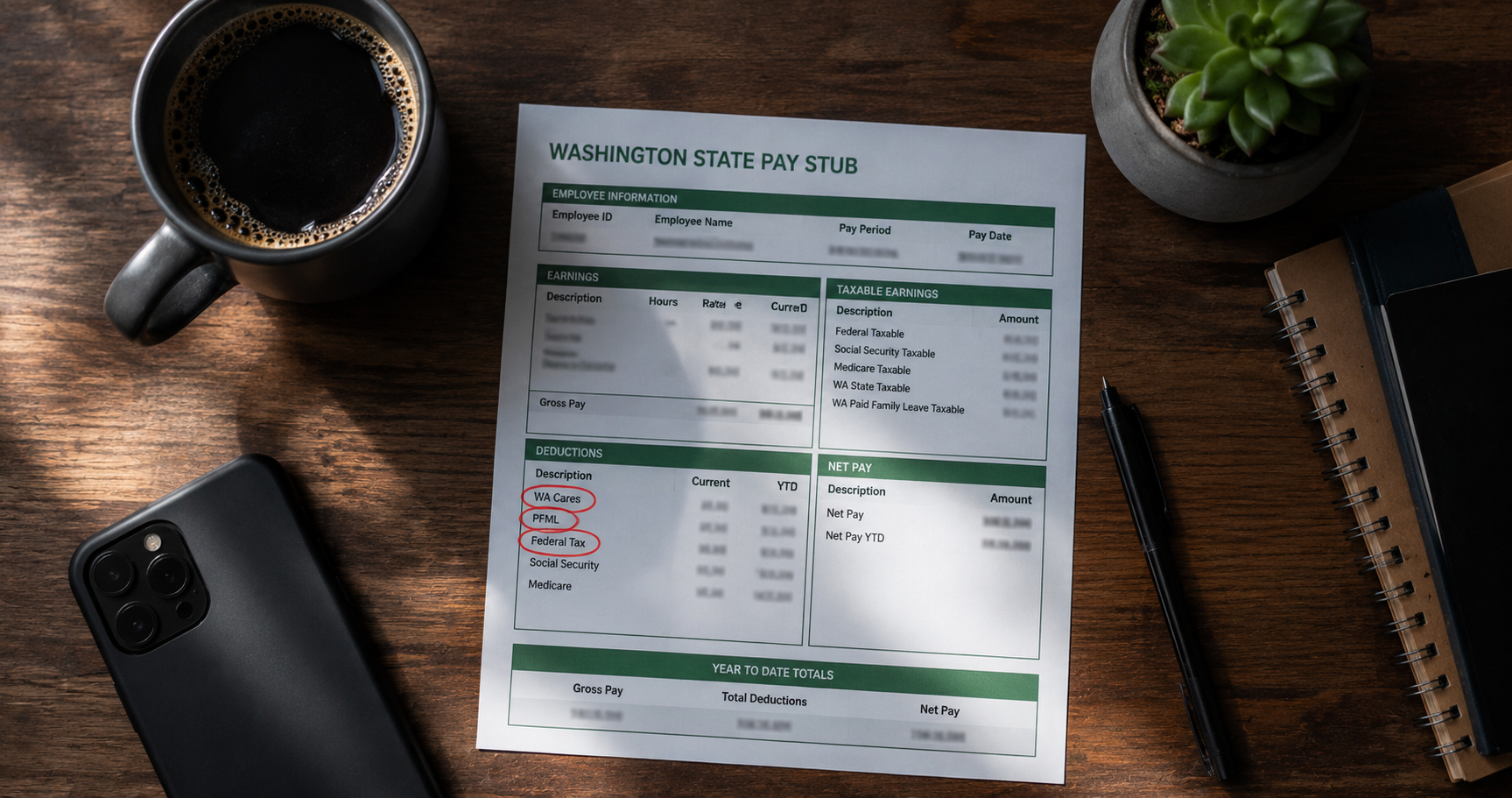
Washington Paycheck Deductions : Most people moving to Washington for a job know the big selling point going in: no state income tax. They do the math on their salary offer, feel pretty good about it, and then the first paycheck arrives.
And there are two lines on the stub they’ve never seen before.
WA Cares Fund — $XX.XX Paid Family & Medical Leave — $XX.XX
If you grew up in a different state, worked in a different state, or just never had anyone walk you through a Washington pay stub, these deductions look mysterious. Some people assume it’s an error. Others just file it away as one of those things they’ll look up later and never quite get around to.
This guide is that explanation. We’re going through every single deduction on a Washington paycheck — the familiar ones and the Washington-specific ones — so you know exactly where every dollar goes and why.
Start Here: Gross Pay vs. Net Pay
Two numbers appear on every pay stub in some form:
Gross Pay = Everything you earned in the pay period before a single dollar is subtracted. It’s your hourly rate times hours worked, or your salary divided by pay periods. This is the number employers advertise when they make job offers.
Net Pay = What actually lands in your bank account after every deduction is applied. This is the number your budget runs on.
The difference between those two numbers is where all the deductions live. In Washington, you have fewer deductions than in most states — but you still have them, and two of them are unlike anything you’d see on a paycheck from most other parts of the country.
Deduction #1 — Federal Income Tax
Federal income tax is almost always the largest deduction on any paycheck, and Washington is no exception.
This money goes to the IRS and funds federal programs. How much gets withheld depends on three things: your gross earnings for the pay period, your filing status, and the withholding choices on your W-4.
The federal system uses progressive brackets — different rates on different slices of income:
| Taxable Income (Single Filer) | Federal Rate |
|---|---|
| Up to $11,925 | 10% |
| $11,926 – $48,475 | 12% |
| $48,476 – $103,350 | 22% |
| $103,351 – $197,300 | 24% |
| Over $197,300 | 32% and above |
One thing to keep in mind: these rates apply to taxable income — your gross income after the federal standard deduction ($15,000 for single filers, $30,000 for married jointly in 2026). So a single Washington worker earning $60,000 is only paying federal income tax on about $45,000 of that — the rest is sheltered by the standard deduction.
Your employer estimates the withholding and takes it out each paycheck. You settle up with the IRS when you file your return in April. Withhold too much and you get a refund. Withhold too little and you owe the difference.
Deduction #2 — Washington State Income Tax
There isn’t one.
Washington has no state income tax — zero, none, nada. It’s one of only 9 states in the country with this distinction, and it’s a real financial advantage for workers.
There’s no state tax withholding on your paycheck, no state tax return to file in April, and no percentage of your wages going to Olympia every two weeks. That money simply stays in your pocket.
What Washington does instead is fund its state programs primarily through sales tax and business taxes. The tradeoff is a 6.5% statewide sales tax (with local additions on top) — but since sales tax only applies when you spend money, workers who save a lot or spend modestly come out well ahead.
Deduction #3 — WA Cares Fund (Long-Term Care Tax)
Here’s one of those two unfamiliar lines.
The WA Cares Fund is Washington State’s mandatory long-term care program. The rate in 2026 is 0.58% of your gross wages with no annual wage cap.
What is this actually for? Long-term care — the kind of help people need when they can no longer fully manage daily activities on their own, whether due to aging, illness, or disability. Things like help bathing, dressing, preparing meals, managing medications, or getting around.
Long-term care is extraordinarily expensive. Nursing home care in Washington can easily run $10,000 or more per month. The WA Cares program builds a fund that eligible workers can draw from — up to $36,500 in benefits, adjusted for inflation over time — if they ever need that kind of support.
To qualify for benefits you generally need to have worked and paid into the program for a minimum number of years. The program is still relatively new and the full eligibility details are on the Washington State Employment Security Department website.
What does it cost you? On a $70,000 annual salary: $406 per year — about $15.62 per bi-weekly paycheck. On a $100,000 salary: $580 per year — about $22.31 per bi-weekly paycheck.
Some workers may be permanently exempt from the WA Cares deduction if they purchased qualifying private long-term care insurance before the program’s exemption deadline. If you have a WA Cares exemption, your employer should not be withholding this deduction. If they are, bring it to HR with your exemption approval letter.
Deduction #4 — Washington Paid Family & Medical Leave (PFML)
The second unfamiliar line — and honestly, one of the more valuable benefits a Washington paycheck funds.
Washington Paid Family & Medical Leave provides paid time off for serious family and medical events. We’re talking about things like:
- Welcoming a new baby (birth, adoption, or foster placement)
- Caring for a seriously ill family member
- Your own serious health condition that prevents you from working
- Certain qualifying military situations
Washington’s PFML benefit is one of the most generous in the country — up to 18 weeks of paid leave for some situations, with a benefit that replaces a significant portion of your wages.
The total PFML premium for 2026 is 0.92% of gross wages. Employees pay approximately 71.43% of this, which works out to about 0.66% of gross wages. Employers with 50 or more employees pay the remaining 28.57%.
There is no wage cap on PFML — it applies to every dollar of wages you earn.
What does it cost you? On a $70,000 annual salary: about $462 per year — roughly $17.77 per bi-weekly paycheck. On a $100,000 salary: about $660 per year — roughly $25.38 per bi-weekly paycheck.
When you actually need paid leave — and statistically, most people will at some point — this deduction pays for itself very quickly.
Deduction #5 — Social Security Tax
Social Security tax funds the federal retirement and disability program. The rate in 2026 is 6.2% of gross wages up to a wage cap of $184,500 per year.
Once your year-to-date earnings hit $184,500, Social Security withholding stops for the rest of the calendar year. For most workers, the cap doesn’t come into play and Social Security applies to every paycheck.
On a $1,000 gross paycheck: $62.00 goes to Social Security.
Deduction #6 — Medicare Tax
Medicare funds federal health insurance for people 65 and older. The rate in 2026 is 1.45% of all wages — no income cap, no exceptions.
On that same $1,000 paycheck: $14.50 goes to Medicare.
Social Security (6.2%) and Medicare (1.45%) are often grouped together on pay stubs as FICA — Federal Insurance Contributions Act. Combined they take 7.65% of gross pay every single paycheck.
Workers earning over $200,000 as single filers pay an additional 0.9% Medicare surtax on income above that threshold.
What Washington Does NOT Take From Your Paycheck
This matters and it’s worth spelling out clearly:
No state income tax. $0.00. This is the biggest one.
No local income tax. Unlike Michigan — where Detroit residents pay an extra 2.4% city income tax — no city or county in Washington charges a local income tax. Seattle, Spokane, Tacoma, Bellevue — same deductions everywhere statewide.
No separate SDI tax. Some states like California charge a State Disability Insurance tax on top of everything else. Washington’s PFML program covers similar needs — there’s no separate SDI deduction.
Full Washington Paycheck Example: $80,000 Salary in Seattle
Let’s put all of this together with a real-world example.
Worker: Single filer, $80,000 annual salary, Seattle, paid bi-weekly Gross pay per paycheck: $3,076.92
| Deduction | Per Paycheck | Annual |
|---|---|---|
| Federal Income Tax | $363.08 | $9,440 |
| Social Security (6.2%) | $190.77 | $4,960 |
| Medicare (1.45%) | $44.62 | $1,160 |
| WA Cares Fund (0.58%) | $17.85 | $464 |
| WA PFML (~0.66%) | $20.31 | $528 |
| WA State Income Tax | $0.00 | $0 |
| Total Deductions | $636.63 | $16,552 |
| Net Take-Home Pay | $2,440.29 | $63,448 |
On an $80,000 salary in Seattle, you take home about $2,440 per bi-weekly paycheck and roughly $63,448 per year — keeping about 79.3% of gross pay.
Now run the same $80,000 salary through Oregon’s tax system — add 9.9% state income tax on top — and that take-home drops by about $5,000 to $7,000 per year. The no-income-tax advantage is real and it compounds over a career.
For your exact number, plug your salary and details into the Washington Paycheck Calculator.
How to Verify Your Washington Pay Stub Is Correct
Most people trust their paycheck without checking it. But errors happen, and a small payroll mistake can quietly cost you money every pay period for months.
Here’s how to do a quick check on your Washington pay stub:
Social Security: Gross pay × 6.2% = Social Security line. If it’s significantly off, ask HR.
Medicare: Gross pay × 1.45% = Medicare line. Same idea.
WA Cares Fund: Gross pay × 0.58% = WA Cares deduction. Easy to verify with a calculator.
PFML: Gross pay × 0.66% ≈ your employee PFML share. Small variations possible depending on your employer’s exact premium calculation.
State income tax line: Should be $0.00. If you see any Washington state income tax being withheld, that’s incorrect — contact HR.
Federal tax: This one is harder to manually verify because it depends on your filing status and W-4 allowances. The easiest check is to run your gross pay through the Washington Paycheck Calculator and compare.
Questions Washington Workers Actually Ask About Their Pay Stubs
I just moved from California. Why do I see WA Cares and PFML on my stub but not SDI anymore? California’s SDI was their disability insurance program. Washington replaced the need for separate SDI with the PFML program, which covers paid leave for medical and family reasons. WA Cares is additional — it’s Washington’s unique long-term care program. They serve different purposes but together they cover the main reasons workers need income protection.
My WA Cares deduction stopped appearing on my stub. What happened? Either you have an approved exemption on file with your employer, or there may be a payroll error. If you have a valid WA Cares exemption approval letter, your employer should not be withholding it. If you don’t have an exemption, the deduction stopping could be a payroll mistake worth flagging.
What does YTD mean next to my deductions? Year-To-Date. It shows the cumulative total of each deduction since January 1st of the current year. Useful for tracking how much you’ve paid in taxes so far and for cross-referencing with your W-2 at tax time.
Can I get the WA Cares Fund money back if I leave Washington? Not directly as a refund. The contributions build eligibility toward future benefits. If you move out of Washington before meeting the eligibility requirements, you generally won’t receive benefits — which is one of the more common criticisms of the program. Workers who relocate frequently may end up paying in without ever qualifying for benefits.
Why does my federal withholding seem high if Washington has no state tax? Washington having no state tax doesn’t affect federal withholding — those are entirely separate. Your federal withholding is based only on your W-4 choices and income level. If it seems too high, update your W-4 with your employer. If it seems too low, the same solution applies.
Is there any way to reduce what I pay into WA Cares and PFML? Not directly — they’re mandatory for most employees and apply to all wages with no cap. Pre-tax deductions like 401(k) contributions do reduce your federal taxable income, but WA Cares and PFML are calculated on gross wages regardless of those deductions.
The Bottom Line
A Washington paycheck is simpler than most states in one key way — no state income tax line, ever. But it has two deductions you won’t see on paychecks from almost anywhere else: the WA Cares Fund at 0.58% and Paid Family & Medical Leave at about 0.66%.
Together those two Washington-specific deductions cost roughly 1.24% of your gross pay. In return you have access to paid leave when life gets hard, and you’re building eligibility toward long-term care benefits down the road.
After everything — federal tax, FICA, WA Cares, and PFML — most Washington workers keep between 73% and 84% of their gross pay. That’s among the highest take-home rates of any state in the country, and it’s directly tied to that zero state income tax line.
To get a complete, accurate breakdown of your specific Washington paycheck, use the free Washington Paycheck Calculator — every deduction calculated correctly, updated for 2026, no account needed.
Sources: Washington State Department of Revenue · WA Employment Security Department (WA Cares & PFML) · IRS Publication 15-T (2026) · Social Security Administration · Updated June 2026
Related Articles
- Washington Paycheck Calculator — Free & Instant Results
- Washington State Income Tax 2026 — Why Washington Workers Keep More
- Washington Minimum Wage 2026 — $16.28/hr & Take-Home Pay Explained
- Michigan Paycheck Deductions Explained
- What Is FICA Tax? A Plain-English Guide (coming soon)