
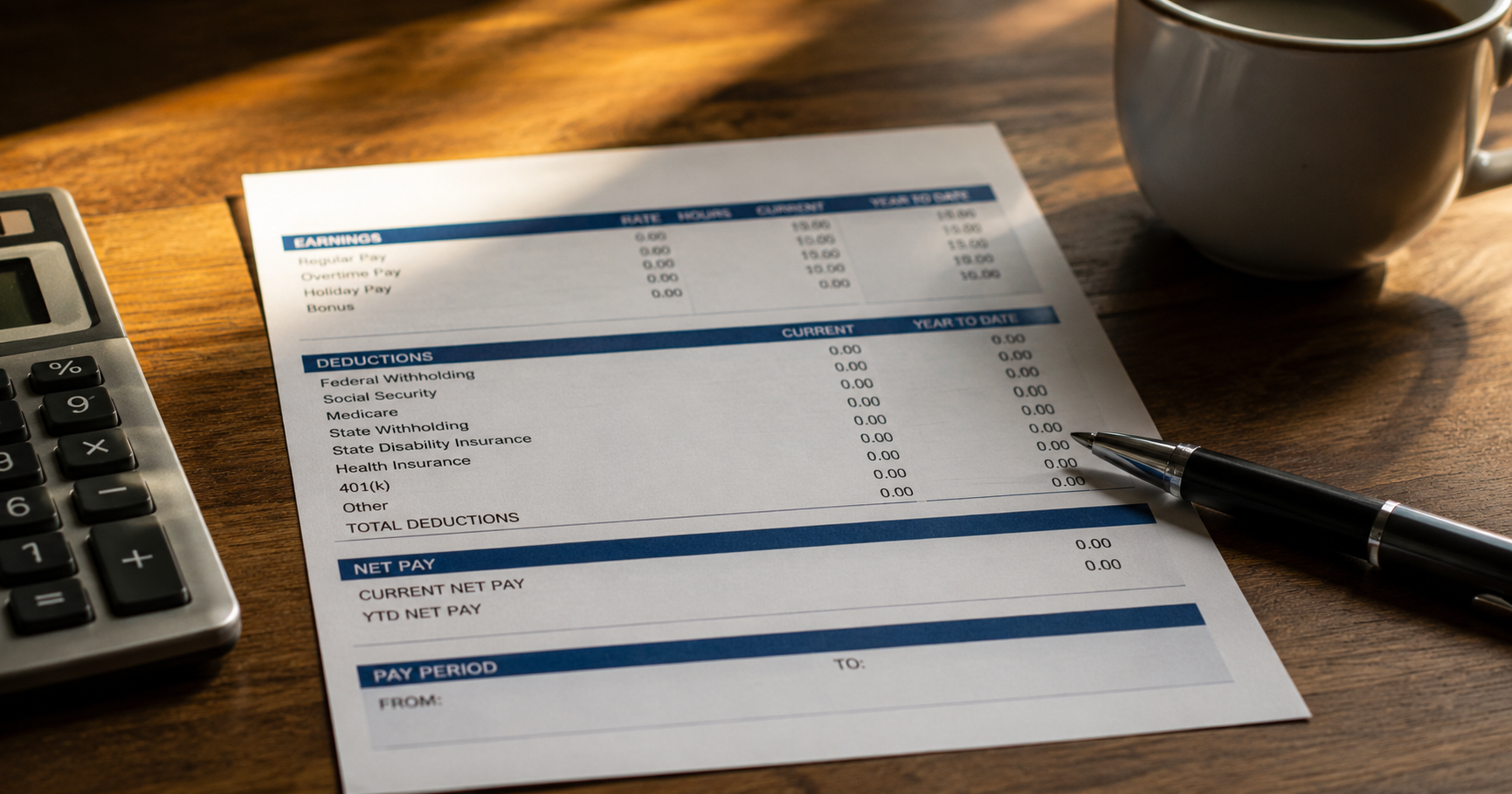
You know your hourly rate. You know how many hours you worked. You did the math on the drive home.
Then you opened your pay stub and the number was noticeably smaller than what you calculated.
Nothing unusual happened. Nothing is being taken unfairly. But a lot of things happen between your gross pay and the money that actually hits your bank account — and most of it happens quietly in the background without anyone sitting you down to explain it.
So let’s do that right now.
Here is every single deduction that comes out of an Idaho paycheck in 2026, what each one is, where the money goes, and how much it actually costs you on a typical paycheck.
Gross Pay vs. Net Pay — Let’s Start Here
Two terms you’ll see on every pay stub:
Gross Pay = Everything you earned before a single dollar is taken out. If you worked 40 hours at $20/hr, your gross pay is $800. This is the number your employer starts with.
Net Pay = What actually lands in your account after all deductions are subtracted. This is the number that matters for your budget.
The gap between those two numbers is made up of taxes and sometimes other deductions. Idaho workers are actually in a pretty good position here — the deductions are fewer and simpler than in most states.
Let’s go through each one.
Deduction #1 — Federal Income Tax
This is usually the single largest deduction on your paycheck, and it goes to the federal government.
How much gets withheld depends on three things: your gross pay for the period, your filing status (single, married, head of household), and the withholding elections you made on your W-4 when you started the job.
The federal tax system uses progressive brackets — meaning different pieces of your income get taxed at different rates. For 2026:
| Taxable Income (Single) | Federal Rate |
|---|---|
| Up to $11,925 | 10% |
| $11,926 – $48,475 | 12% |
| $48,476 – $103,350 | 22% |
| $103,351 – $197,300 | 24% |
| Over $197,300 | 32% and above |
Most Idaho workers earning between $35,000 and $80,000 a year will see the 10% and 12% brackets hit most of their income. The 22% bracket starts at $48,476 — so if you earn above that, a portion of your income gets taxed at 22%, but not all of it.
One thing worth understanding: your employer withholds an estimate every paycheck. You reconcile with the IRS when you file your return in April. Withhold too much all year and you get a refund. Withhold too little and you owe the difference.
Deduction #2 — Idaho State Income Tax
On top of federal tax, Idaho takes its own slice for state services — schools, roads, public safety, and so on.
Here’s what makes Idaho different from most states: there are no brackets. Idaho uses a flat tax.
Idaho state income tax rate: 5.8% flat for everyone.
It doesn’t matter if you earn $25,000 or $250,000. Same rate. The only thing that reduces your taxable income before the 5.8% applies is Idaho’s standard deduction:
- Single filers: $16,100
- Married filing jointly: $32,200
So if you earn $55,000 as a single filer, Idaho taxes you on $55,000 minus $16,100 = $38,900 taxable income. That comes out to $2,256 in Idaho state tax for the year — or about $87 per bi-weekly paycheck.
For most Idaho workers, state income tax ends up being the second-largest deduction after federal income tax.
Deduction #3 — Social Security Tax
This one surprises people who see it on their pay stub for the first time. It has nothing to do with income tax — it’s an entirely separate deduction that funds the federal Social Security retirement and disability program.
The Social Security tax rate in 2026 is 6.2% of your gross wages.
There is an upper income limit — once you’ve earned $184,500 in a calendar year, Social Security tax stops being withheld for the rest of that year. For the vast majority of Idaho workers earning well under that ceiling, it applies to every dollar of every paycheck.
On a $1,000 paycheck: $62.00 goes to Social Security. Every time.
Deduction #4 — Medicare Tax
Medicare tax works the same way as Social Security — it’s a flat percentage on every paycheck — but the rate is lower and there’s no income cap at all.
The Medicare tax rate in 2026 is 1.45% of gross wages.
On that same $1,000 paycheck: $14.50 goes to Medicare.
Social Security (6.2%) and Medicare (1.45%) are often grouped together on your pay stub under one label — FICA — which stands for the Federal Insurance Contributions Act. Combined, FICA takes 7.65% of your gross pay on every single paycheck, no exceptions.
Higher earners take note: If you earn over $200,000 per year as a single filer, an additional 0.9% Medicare surtax kicks in on income above that threshold. This affects a relatively small number of Idaho workers but it’s good to know.
What Idaho Does NOT Deduct — Good News
Here’s where Idaho workers genuinely come out ahead compared to workers in many other states.
No SDI tax. California workers, for example, pay a State Disability Insurance (SDI) tax of around 1.1% on every single paycheck. Idaho has no SDI program and no SDI deduction at all.
No local income tax. In states like Ohio, Pennsylvania, and Kentucky, workers can face separate city or municipality income taxes on top of everything else. In Idaho, there are no local income taxes anywhere in the state. Whether you work in Boise, Meridian, Nampa, Twin Falls, or Pocatello — the only state-level tax on your wages is the flat 5.8%.
Fewer deductions mean a simpler pay stub and — in most cases — more money in your pocket compared to workers in states that pile on additional taxes.
Optional Deductions — The Ones You Control
Everything above is mandatory. But there’s another category of deductions that you choose — and these are worth paying close attention to because they can reduce your overall tax bill.
401(k) or 403(b) Retirement Contributions
When you contribute to a traditional 401(k), that money comes out of your paycheck before federal and Idaho state income tax is calculated. That’s a big deal.
In 2026 you can contribute up to $24,500 per year (or $31,000 if you’re 50 or older). Every dollar you contribute reduces your taxable income — meaning you pay 5.8% less in Idaho state tax, plus whatever you save federally, on every dollar you put in.
If your employer matches contributions and you’re not contributing enough to get the full match, you’re essentially leaving free money on the table.
Health Insurance Premiums
Most employers deduct health insurance premiums pre-tax through a Section 125 cafeteria plan. This means your health insurance cost reduces your taxable income before taxes are calculated — not after.
Check your pay stub. If your health insurance appears under “pre-tax deductions,” you’re already getting this benefit automatically.
HSA Contributions
If you have a qualifying high-deductible health plan, Health Savings Account contributions are pre-tax up to $4,400 per year for single coverage and $8,750 for families. The money grows tax-free and can be withdrawn tax-free for qualified medical expenses. Unused funds roll over every year — it doesn’t disappear on December 31st like a Flexible Spending Account.
Post-Tax Deductions
Some deductions come out after taxes — things like Roth 401(k) contributions, supplemental life insurance, and wage garnishments. These don’t reduce your taxable income but they do reduce your net pay. Look for a “post-tax deductions” section on your pay stub to see if any of these apply to you.
A Real Idaho Paycheck Example
Let’s put all of this together with a concrete example so you can see the full picture.
Worker: Single filer, $65,000 annual salary, paid bi-weekly (26 paychecks per year) Gross pay per paycheck: $2,500.00
| Deduction | Per Paycheck | Annual Total |
|---|---|---|
| Federal Income Tax | $245.00 | $6,370.00 |
| Idaho State Tax (5.8%) | $107.43 | $2,793.00 |
| Social Security (6.2%) | $155.00 | $4,030.00 |
| Medicare (1.45%) | $36.25 | $942.50 |
| Total Deductions | $543.68 | $14,135.50 |
| Net Take-Home Pay | $1,956.32 | $50,864.50 |
On a $65,000 salary in Idaho, you’re taking home roughly $1,956 per bi-weekly paycheck and about $50,865 per year — before any optional deductions like 401(k) or health insurance.
That’s about 78% of your gross pay staying in your pocket. Not bad compared to high-tax states.
Want to run your own numbers? The Idaho Paycheck Calculator does the full calculation for any salary, any pay frequency, and any filing status in seconds.
How to Verify Your Pay Stub Is Correct
Most people trust their pay stub without checking it. But payroll errors happen — and they often go unnoticed for months or even years. Here’s a quick way to do a sanity check:
Check Social Security: Multiply your gross pay by 6.2%. The result should match the Social Security line on your stub. If it’s significantly different, ask your payroll department.
Check Medicare: Multiply gross pay by 1.45%. Same idea.
Check Idaho state tax: This one is easiest to verify with the Idaho Paycheck Calculator. Enter your gross pay and filing status and compare the result to what your stub shows.
Review your W-4: If your federal withholding looks way too high or too low, your W-4 settings are usually the reason. You can update your W-4 with your employer at any time — it’s not locked in when you’re hired.
Look for mystery deductions: Every single line on your pay stub should be explainable. If you see a deduction you don’t recognize, ask HR before assuming it’s correct.
Questions Idaho Workers Ask About Pay Stub Deductions
What does YTD mean on my pay stub? YTD stands for Year-To-Date. It shows how much of each deduction has been taken since January 1st of the current year. It’s useful for tracking how much total tax you’ve paid and for comparing against what you’ll owe when you file your return.
Why does my federal withholding amount change slightly between paychecks even though my salary is the same? Small variations in hours, any bonuses, retroactive adjustments, or changes to how your payroll period falls on the calendar can all cause slight shifts in the withholding calculation. It’s normal as long as the changes are small.
Can I ask my employer to withhold more or less federal tax? Yes. You can submit an updated W-4 to your employer at any time requesting additional withholding or reducing it. Just be careful about reducing it too much — underwithholding can result in an unexpected tax bill plus potential penalties in April.
I have two jobs in Idaho. Will I owe more taxes? Not more taxes in total — but two jobs together can push your income into a higher federal tax bracket than either job alone would. The withholding on each job is calculated independently, so the combined withholding might not be enough. Use the IRS Tax Withholding Estimator to check.
My bonus showed up on a separate check. Why was so much tax taken out? Federal law allows employers to withhold a flat 22% from supplemental pay like bonuses paid on a separate check. This is called the percentage method. It doesn’t mean you owe 22% — you’ll settle up with the IRS when you file, and if too much was withheld you’ll get a refund.
The Bottom Line
An Idaho paycheck goes through four mandatory deductions before it reaches you: federal income tax, Idaho’s flat 5.8% state income tax, Social Security at 6.2%, and Medicare at 1.45%. No SDI, no local taxes — just those four.
Understanding every line on your pay stub means you can spot errors before they go on for months, make smarter decisions about your W-4 and your benefits elections, and budget accurately around what you actually bring home rather than what you earn on paper.
For a complete, accurate breakdown of your specific Idaho paycheck after every deduction, use the free Idaho Paycheck Calculator — updated for 2026, completely free, no account needed.
Sources: IRS Publication 15-T (2026) · Idaho State Tax Commission · Social Security Administration · Updated June 2026
Related Articles
- Idaho Paycheck Calculator — Free & Instant Results
- Idaho Income Tax Guide 2026 — The Flat 5.8% Rate Explained
- Idaho Minimum Wage 2026 — What Workers Need to Know
- Arkansas Paycheck Deductions Explained
- What Is FICA Tax? A Plain-English Guide (coming soon)